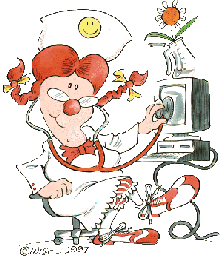
Send In The Clowns! Part IIFrom Journal of Nursing Jocularity, Spring 1993, 3(1), pp 46-47.by Patty Wooten, RNĘBSNĘPHN Rx: "Send in the clowns." Perhaps someday that will be as common as "Tylenol prn", or "M.O.M. at hs." Specially trained clowns are being allowed to visit patients in many hospitals and nursing homes, where they are providing a much needed service. In my last column we explored the concept of the Caring Clown, discussed their purpose, and established guidelines for integrating this service into hospitals and nursing homes. This column reveals some of the activities and routines that clowns have found effective to use at the bedside. In preparation for this, I interviewed Bonnie Donaldson and Janet Tucker - both Clown Camp instructors and actively involved in their community hospitals providing clown visitation services. I also spoke with Michael Christensen (director of the Big Apple Circus Clown Care Unit in New York City) and Kenny Ahern (an instructor for Ringling Brothers Clown College and the Clown Camp). Kenny will be performing in St. Louis at the Journal of Nursing Jocularity Conference; and he and I will be teaching a session there about caring clowns. The style and activities of these clowns varied but they all agreed to a similar purpose for their work . . . to bring a few moments of joy and perhaps laughter to people who are sick, frightened, and lonely. Their antics are geared to distract the patients and perhaps trigger memories of happier times. Because the clown has a universal appeal and trust, and is not part of the health care team, patients or families will often confide in them and share thoughts or emotions they keep hidden from professional staff. In these cases, clowns listen empathetically and at some point may offer: "Can I show you something that may help you feel better?" which creates an opening back to their original goal for being there. Each of the clowns I spoke with indicated how they needed to remain open and sensitive to the individual's needs in any given moment rather than insisting on performing a certain prepared routine.
Some clowns will stand just inside the door and talk with a puppet - "Do you think it's okay for us to come in here?" After the puppet nods, the clown will ask the patient. Another possible opening is to announce that you are going to give them a parking ticket because they've been in the hospital too long. Sometimes Janet and her partner discuss plans for the "big party" to be held in this room later: They can see the flowers have arrived so this must be the place, and they ask the patient if he/she has ordered the band and the dancing girls yet. Bonnie shares that if she sees a kid hooked up to lots of equipment, she attempts to reinterpret its purpose rather than ignore that its there. "Hey, you must be Robo-Kid, and they're giving you all kinds of secret stuff to make you extra strong. Michael uses fuzzy toys that wind up and spin or jump and then gives the command just before the toy is expected to do something. Janet pulls out a large plastic bone and announces: "This is a Funnybone, they found it down in surgery. Saaaay, did you lose your funny bone since you came into the hospital?" Other funny props include a pair of glasses with prescription bottles glued to the lens ("These are my prescription glasses") or a pair with a box of Contact glued to each lens ("These are my contact lenses"). Pocket-sized magic tricks are easy to carry and always a delight for young and old alike. Most clowns like to leave a small gift with the patient to remind them of the visit. Balloon animals should be avoided and are usually prohibited in hospitals - children have been known to suffocate and die from inhaling the latex of a broken balloon. Food or candy should be avoided unless the hospital provides it for you. Appropriate gifts include stickers which may be applied to the hospital gown or water pitcher - messages for pitchers include: "I met a clown today!", "IYQ", & "URAQT". Some clowns carry a Polaroid camera and, if the patient wishes, their photo is taken with the clown & left as a souvenir. Both Janet and Bonnie like to leave a paper "puzzlesheet" with riddles, games, and puzzles to solve. They also include a cartoon caricature drawing of the clown for the children to color. Richard Snowberg, director of Clown Camp and author of The Caring Clown, summarizes the services aptly. "Our significance is sometimes hard to measure. The people we're playing to are in a situation and environment that, by and large, they haven't chosen. They didn't elect to be in a nursing home or hospital, and they are generally not happy about what has happened to them to cause them to be there. As a result, the clown is a fantasy character who can go in and help remove them from that environment by helping them recall mental images of their youth and fun experiences they've had." If you wish to become a clown, you can attend Clown Camp in LaCrosse, Wisconsin, during the month of June (see Bibliography) or ask them about "Clown Camp on the Road" -- the touring weekend clown workshop. If you want to learn more about Caring Clowning, attend the workshop Kenny Ahern and I will be teaching in St. Louis at the Journal of Nursing Jocularity Conference in May 1993. Bibliography:
This article was originally published in "Jest for the Health of It", a regular feature in the Journal of Nursing Jocularity. Copyright Patty Wooten. Feature columnist Patty Wooten, BSN, is also a past President of the American Association for Therapeutic Humor, author of two books related to humor, and a national speaker presenting on the benefits of humor. |
|